What to Do Before a Presentation to Beat Stage Fright (A Simple 5-Step Routine)
Andy Nadal
Author
Your name gets called, and suddenly your body acts like there's a fire. Heart racing. Chest tight. Thoughts moving too fast to catch. That's stage fright. It'...
Your name gets called, and suddenly your body acts like there's a fire. Heart racing. Chest tight. Thoughts moving too fast to catch.
That's stage fright. It's not a personality flaw, it's your brain trying to protect you. The problem is that it treats a room full of people like a threat.
The fix doesn't have to be dramatic. You need five small moves you can repeat every time, starting with breathwork. Pausa was built after real panic attacks, for those moments when breathing feels hard and your mind won't slow down. It's short, guided breathing, designed for real life, and you don't have to "know how to meditate" to use it.
One note, before we start: if anxiety feels constant, overwhelming, or starts to limit your daily life, consider talking with a licensed mental health professional. You deserve support that fits.
First, calm your body in 5 minutes with guided breathing (this is the biggest win)
 Someone taking a quiet hallway breath break before speaking, created with AI.
When stage fright hits, most people try to think their way out. That's like trying to smooth a stormy lake with your hands. Start with the body instead, because breathing is biology.
Slow breathing sends a clear signal: "We're safe enough to settle." Your shoulders drop. Your jaw softens. Your voice steadies because your air stops coming in panicky gulps.
Research and real-world practice keep landing on the same idea: a short breathing session can calm nerves fast, even in about five minutes. The goal isn't to erase fear. It's to lower the volume so you can speak.
If you want guidance without counting perfectly, use a short audio session in Pausa's guided breathing app. It's available on iOS and Android, built for quick pauses, not long meditation sessions. It can also replace the usual "scroll break" with something that actually helps.
A good pre-presentation breath doesn't make you fearless, it makes you functional.
If you want extra technique ideas, this list of breathing tricks for speaking nerves is a helpful reference. Still, the simplest plan is the one you'll repeat.
A quick pre-talk routine you can do in the hallway or bathroom
This routine takes about 90 seconds. It works in a hallway, stairwell, or bathroom stall. Do it where you can be boring and private.
- Reset posture: Feet hip-width apart, knees soft, shoulders down.
- Hand on belly: Feel it rise and fall. This keeps your breath low and steady.
- Inhale through your nose for 4 seconds.
- Exhale longer than you inhale (aim for 6 to 8 seconds).
- Repeat 5 to 8 cycles.
Want a simple pattern? Try box breathing (inhale 4, hold 4, exhale 4, hold 4). Or use 4-7-8 if it feels comfortable. If counting makes you tense, let Pausa count for you. The audio acts like rails on a staircase. You just step.
This is the routine for the moment when your chest feels tight and your thoughts race. You're not fixing your whole life. You're giving your body a new instruction.
Use Pausa like a tiny coach, pick how you feel, then follow along
Stage fright isn't one feeling. Some days it's shaky energy. Other days it's a heavy, tired fog. That's why "just breathe" can feel useless. Breathing helps most when it matches your state.
Pausa keeps it simple: you show up as you are, choose how you feel (anxious, stressed, unfocused, exhausted), then follow a short guided pattern. It's designed as companionship in the moment, like someone saying, "I'm here, breathe with me."
Because it's built for short pauses, it also helps with screen time. Instead of opening your phone to numb out, you open it to come back to yourself. That shift matters right before a presentation.
Make your talk feel familiar, so your brain stops yelling "danger"
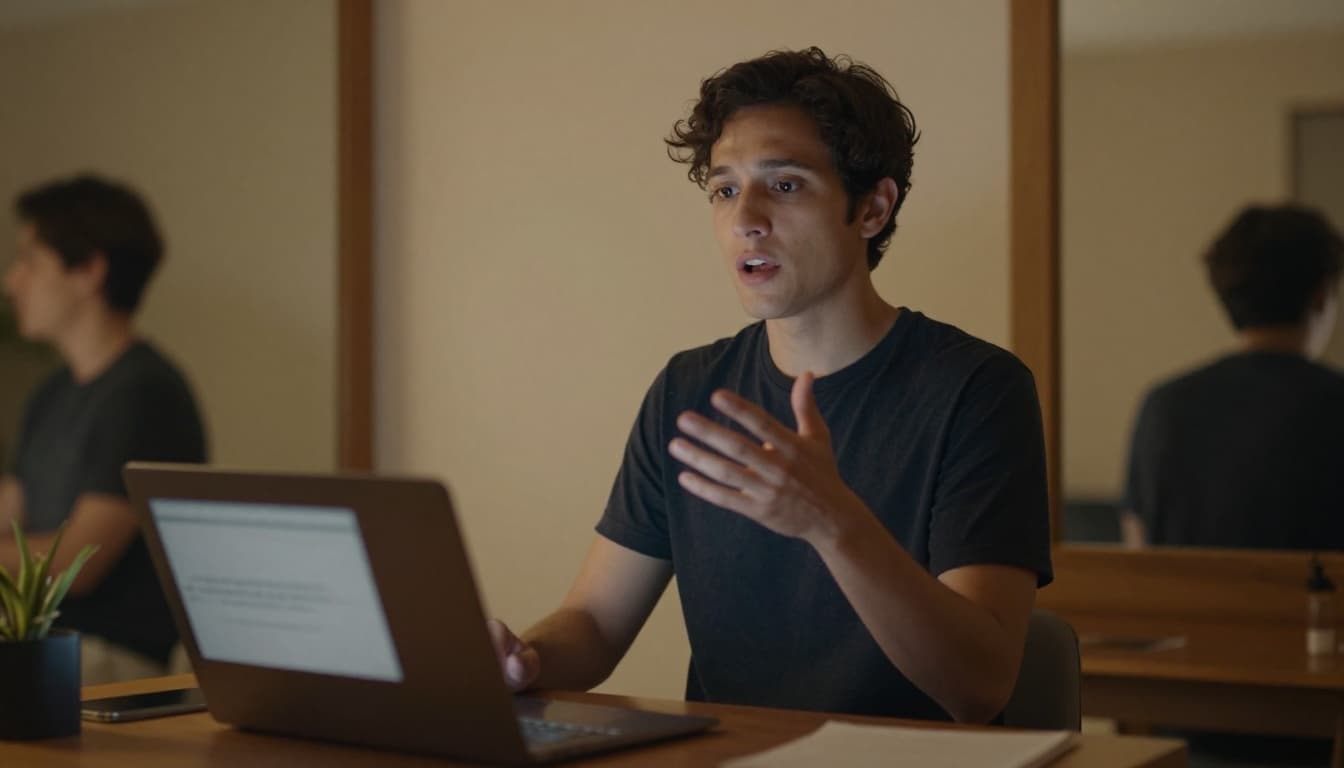 Practicing a first minute out loud at home, created with AI.
Once your body calms, reduce uncertainty. Stage fright feeds on the unknown. Your brain imagines a blank mind, a judging crowd, a tech disaster, then hits the panic button early.
So make the talk feel familiar before you ever step up. Not perfect, familiar.
A simple way to do that is to "lock in" your first 60 seconds. When you know exactly how you start, the hardest part becomes automatic. After you begin, nerves usually drop a notch because your brain sees proof you're surviving.
If you want a deeper look at what actually helps (and what doesn't), this piece on why "just breathe" can fail explains how practical rehearsal changes your stress response.
Practice your opening out loud until it feels like muscle memory
Write a clean opening that does three jobs:
- One line to connect (who you are, why you're here).
- One promise (what they'll get in the next few minutes).
- One early point you can explain without slides.
Then practice it standing up. Use your real voice, not your "reading voice." Run it with a timer. Do it once with slides, once without.
Record yourself one time. Watch it once. Fix only one or two things. That limit is important because stage fright loves endless tweaks. Improvement beats perfection.
Do a fast "tech and room" check to remove surprise stress
A two-minute check can prevent a ten-minute spiral.
For in-person talks: test your clicker, plug in, check audio, open the right file, and make sure your fonts look normal. Find where you'll stand, where the water is, and where you'll look when you need a friendly face.
For virtual talks: check camera angle, lighting, and sound. Turn off notifications. Close extra tabs. Put your notes at eye level so you don't keep looking down.
Fewer surprises means fewer stress spikes. It's that simple.
If your presentation anxiety overlaps with interview pressure, this guide on managing stress in job interviews has a useful way to talk about stress without sounding rehearsed.
Turn shaky energy into steady confidence right before you step up
 Adjusting posture and settling the breath on stage, created with AI.
Right before you go on, your body may still buzz. That's normal. The goal now is to shape that energy into something useful.
Think of nerves like wind. Wind can knock you over, or it can fill a sail. Your job is to set the sail.
Here are two fast resets that take under two minutes total. They're simple, but they work because they change what your body is doing right now.
Stand tall, loosen your jaw, and let your face tell your body it's safe
Plant your feet like you're standing on solid ground, because you are. Drop your shoulders. Then relax your jaw and tongue. Many people clench without noticing, and it tightens the voice.
Take one slow exhale before you speak. Long exhale first, then inhale naturally. Your voice often steadies on the exhale.
A "power pose" can help some people, but don't force it. Aim for calm strength, not a superhero stance. Pair posture with two slow breaths and you'll feel the difference.
Confidence often looks like a person who can pause without apologizing.
Swap "I'm scared" for one sentence that keeps you moving
You don't have to argue with fear. Give it a job.
Try one of these short lines, then take one slow breath:
- "My body is getting me ready."
- "I can be nervous and still be clear."
- "I'm here to help, not perform."
Also, give yourself permission to pause during the talk. A short pause can look thoughtful and steady. It can also give you time to breathe.
For more ideas on building speaking confidence over time, this public speaking confidence guide offers practical techniques you can practice between presentations.
Conclusion
Stage fright is loud, but it's not in charge. Before your next presentation, do five things: calm your body with five minutes of guided breathing, rehearse your first 60 seconds out loud, remove surprise stress with a quick tech check, reset posture and jaw, then use one steadying sentence to keep moving.
Most importantly, make breathwork the habit. A short session with Pausa can become your repeatable ritual, backstage, in the hallway, or in a bathroom stall. Small pauses add up, and you don't have to feel alone with stage fright.