Stage Fright in Front of a Huge Crowd: How Breath Work Reduces Anxiety and Helps You Speak
Andy Nadal
Author
An executive practicing a steadying breath under pressure, created with AI. The room goes quiet. The stage lights feel too bright. Your name hits the screen,...
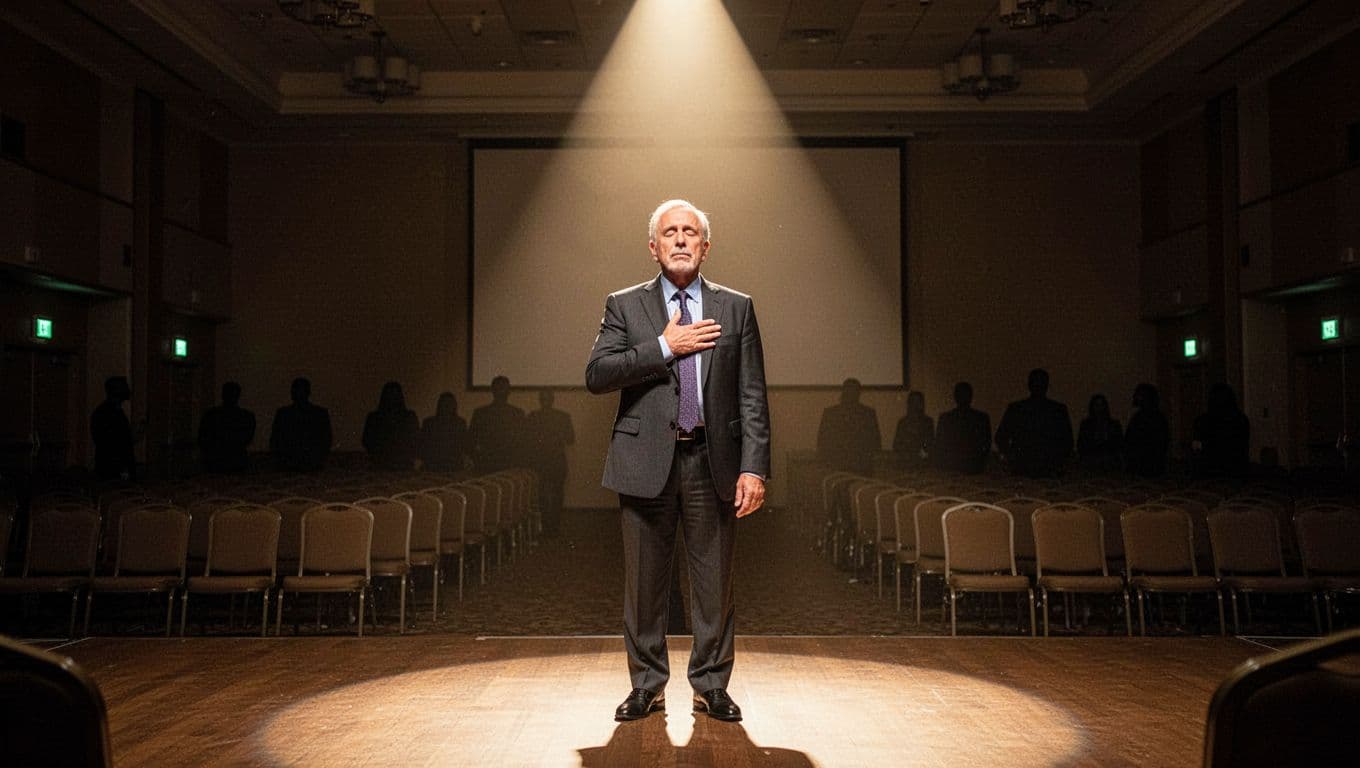 An executive practicing a steadying breath under pressure, created with AI.
The room goes quiet. The stage lights feel too bright. Your name hits the screen, and suddenly your heartbeat is louder than the sound system.
If you've felt stage fright before a keynote, all-hands, pitch, or panel, you're not broken. Stage fright is a body response, not a character flaw. Your system reads "big crowd" as "big risk," and it hits the alarm.
The fastest way to turn down that alarm isn't another pep talk. It's breath work. Not a long meditation. Not a perfect ritual. Just a few minutes of guided breathing that slows the surge and gives you your voice back.
That's also the idea behind Pausa. It was built after real panic attacks, when "think positive" didn't touch the physical symptoms. The answer wasn't complicated. It was short, practical breathing sessions that work in real life, even on a bad day.
In this guide, you'll learn what stage fright really is, a 5-minute reset you can do anywhere, how to step in front of a huge crowd without freezing, and what to do if panic spikes mid-talk.
What stage fright really is, and why your body hits the alarm button
Your brain cares about status and safety. A huge crowd can feel like a judgment machine, even when the audience wants you to succeed. So your nervous system prepares for action.
That's why stage fright often looks like this: adrenaline rises, your heart speeds up, and your breath gets quick and shallow. Blood moves toward big muscles, not fine control. Your voice may tighten. Your focus narrows, like tunnel vision.
In other words, your body is trying to help you perform. The problem is that it often overshoots. Instead of "ready," you get "revving."
Corporate settings add extra triggers:
- A microphone that makes every shake feel bigger
- A high-stakes Q and A where you can't script the next line
- A room full of peers, board members, or investors
- A recording light, because now it "lasts forever"
- A slide clicker that suddenly feels like a tiny detonator
Breath is the simplest lever you can pull in the moment. You can't command adrenaline to disappear. You can change the pace of your breathing, and your body tends to follow that signal.
For a helpful explanation of why "just breathe" can feel useless unless you use a clear pattern, see this breakdown of why "just breathe" often fails before presentations.
If you want a practical way to talk about staying steady under pressure at work, this Pausa Business article on managing stress in job interviews with practical techniques uses a simple, real-world structure you can borrow for speaking prep, too.
The most common signs, racing thoughts, dry mouth, and a voice that won't land
Stage fright isn't just "nerves." It's a whole-body event, and it can show up before, during, or even after the talk.
Physically, you might notice a dry mouth, tight throat, shaky hands, sweating, or a fluttery stomach. Some people feel a pounding heart or a hot face. Others go cold. Mentally, it can look like racing thoughts, a sudden blank mind, or the feeling that time speeds up.
Here's the reframe that matters: these signs don't mean you're unprepared. They mean your body is trying to protect you and push energy into the moment.
Do this 10-second self-check right now:
- Jaw: Is it clenched or hanging tight?
- Shoulders: Are they creeping toward your ears?
- Breath speed: Is your inhale sharp, like sipping air?
- Grip: Are you squeezing your phone, notes, or clicker?
If you can spot the signal early, you can downshift early. That's the difference between "nervous" and "spiraling."
Why breath work helps when pep talks fail
Pep talks live in your thoughts. Stage fright lives in your body.
You can tell yourself, "I've done this before," and still feel your throat tighten. That's because your nervous system doesn't respond to logic first. It responds to cues of safety, and breathing is one of the loudest cues you control.
When you slow your breathing and lengthen the exhale, you send a calmer rhythm through the system. Your voice often steadies because you stop chasing air. Your pace improves because you stop sprinting through sentences.
This is why short guided breathing works well for busy leaders. It's direct. It doesn't require "getting into the right mindset." It also doesn't demand you sit perfectly still for 20 minutes. You can do it in a hallway, in a bathroom stall, or behind the curtain.
If you want another public speaking specific view of this mind-body loop, this overview of breathing techniques for public speaking anxiety relief lines up with what many coaches see in high-pressure rooms.
A 5-minute breathing plan you can use before walking on stage
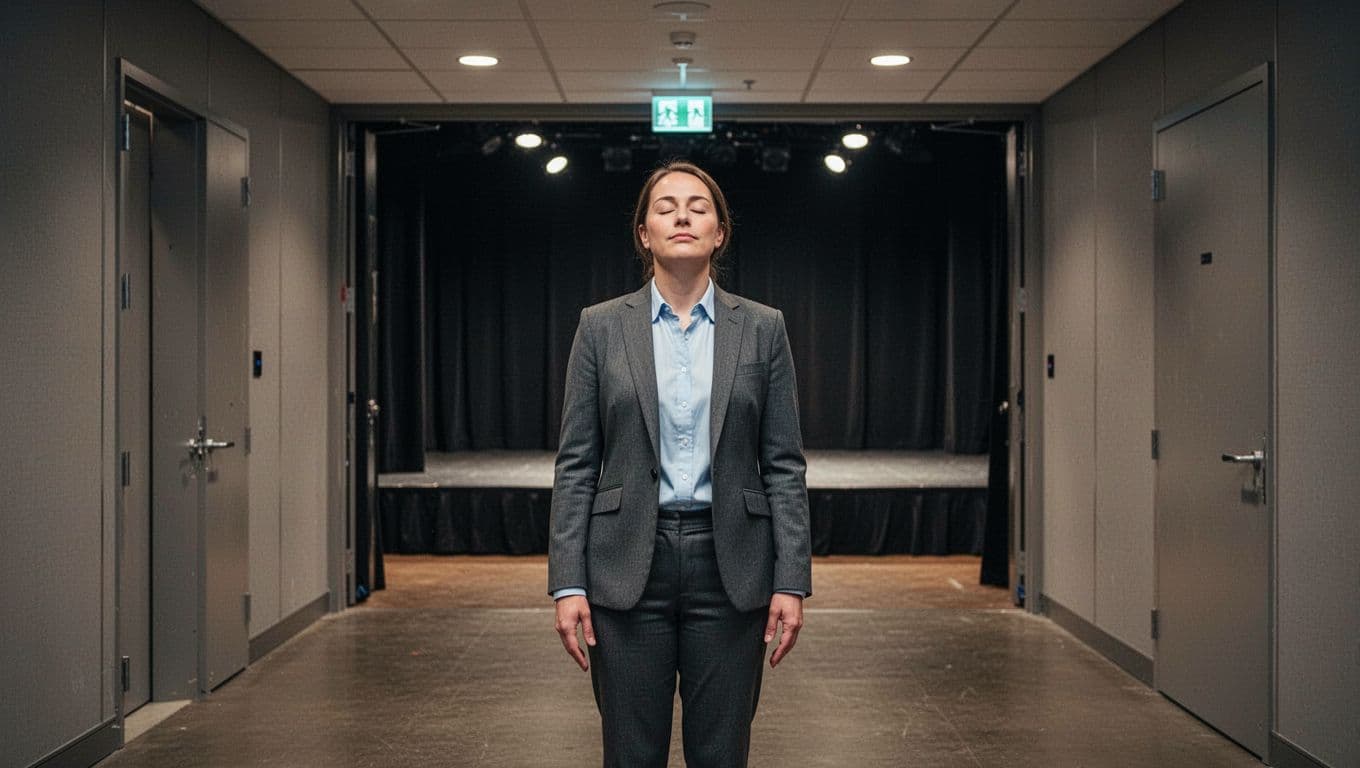 A backstage breathing reset before stepping out, created with AI.
Five minutes is enough to change how your body feels. Not forever, but long enough to walk out steady.
Find a spot where you can stand tall. Put both feet on the ground. Let your arms hang heavy for a second. Most importantly, breathe gently. If you force big breaths, you can get lightheaded.
Here's a simple plan with timing:
- Minute 1: set posture
Stand with knees soft. Unclench your jaw. Let your tongue rest at the bottom of your mouth. Then take three easy nasal breaths, if you can. - Minutes 2 to 3: choose one pattern
Use box breathing if you feel keyed up. Use resonant breathing if you feel rushed and breathless. - Minute 4: "voice warm" on an exhale
On the next few exhales, quietly hum or sigh. Keep it subtle. You're telling your throat it doesn't need to brace. - Minute 5: rehearse your first two sentences
Don't rehearse the whole talk. Just the opening. Start each sentence on an exhale, like you're placing it down.
If you want a guided timer and calm audio in your pocket, download Pausa. It offers science-backed sessions like box breathing and resonant breathing, built for real life. You don't need meditation experience. You just need a moment to pause. As a bonus, it's designed to reduce mindless screen time, because it nudges you away from doomscrolling and back into your body.
For more breathing ideas used in performance settings, this set of breathing exercises for acting and public speaking can help you build variety into practice days.
Small note that changes everything: if you feel dizzy, you're probably breathing too much, not too little. Make the breaths softer, not bigger.
The pre-talk reset, box breathing to slow the surge
Box breathing is simple and structured, which helps when your brain wants to spin stories.
Try this version:
- Inhale for 4
- Hold for 4
- Exhale for 4
- Hold for 4
- Repeat for 4 rounds
Keep the breath light, like you're filling a glass, not a balloon. Breathe through your nose if possible, because it naturally slows the flow. If the holds feel intense, shorten them.
Beginner option:
- Inhale 3, hold 3, exhale 3, hold 3
Box breathing can steady a shaky voice because it slows your breathing rate and reduces that "I'm running out of air" feeling. It also gives your mind a job, counting, instead of catastrophizing.
The calm and clear option, resonant breathing for a smoother voice
Resonant breathing is slow, even breathing with no holds. It's great when you tend to rush.
Try:
- Inhale for 5 seconds
- Exhale for 5 seconds
- Continue for 2 to 4 minutes
Don't force the count. The goal is smoothness. Keep shoulders relaxed. Let the exhale feel like a release, not a push.
This pattern often improves speaking because it trains pacing. Your sentences land with space around them. Your tone drops a notch. You sound less like you're escaping the stage, and more like you're leading the room.
How to step in front of a huge crowd without freezing
 A speaker holding steady rhythm in a large room, created with AI.
Breathing gets you to the starting line. Then behavior keeps you from slipping back into panic.
When you walk out, your brain may hunt for danger. A cough. A blank face. Someone checking a phone. The trick is to give your attention a job that supports your breath, not your fear.
Start with mechanics:
Plant your feet and feel the floor. Keep your knees unlocked so you don't freeze like a statue. Then speak your first line slower than feels natural. Your nerves will try to speed you up. Don't negotiate with them. Set the tempo on purpose.
This also matters for different formats:
- Keynote: take more pauses, because the room is large and sound needs space.
- Panel: exhale before you jump in, so you don't interrupt with a rush of words.
- All-hands: look for steadiness, not hype, because your team mirrors your nervous system.
- Pitch: slow the first 60 seconds, because investors decide "trust" early.
If you want additional tactics that mix breathing with practical delivery, Acuity Training shares several in this guide to breathing tricks that calm speaking nerves.
Use micro-pauses so your breath leads the room, not your nerves
A micro-pause is a 1 to 2 second stop after a key sentence. It feels long on stage. In the audience, it feels like confidence.
Use it in three places:
First, right after your opening line. Next, after a number or claim that matters. Finally, before you transition to the next idea.
A sip of water can become a breathing cue, too. Sip, swallow, then let a slow exhale happen before the next sentence. That exhale is your steering wheel.
Try this simple internal cue: "slow exhale, next sentence." It's not a mantra. It's a direction.
A simple focus trick, pick three friendly faces and rotate
Freezing often starts with frantic scanning. Your eyes dart, your breath speeds up, and your voice follows.
Instead, pick three "anchors":
Left side of the room, center, right side. Speak one idea to the left anchor, then exhale and shift to center, then exhale and shift to right. You'll look natural, not robotic, and your breath will stay organized.
If direct eye contact spikes anxiety, look at foreheads or the space just above someone's eyes. Nobody will notice. Your body will notice, and it will stay calmer.
If panic hits mid-speech, do this in real time without anyone noticing
 A discreet pause that doubles as a nervous-system reset, created with AI.
Sometimes stage fright doesn't fade. Sometimes it spikes.
If that happens, you don't need to "push through" with brute force. You need a discreet protocol. Think of it like an emergency exit sign you can reach without leaving the room.
Also, don't shame yourself. Panic is loud, and it can feel personal. It isn't. It's your nervous system doing its best with the cues it has.
Pausa's approach is built for moments like this, short guided sessions that feel like companionship when anxiety hits. The key is practice, because tools work better when they're familiar. Do a few sessions on calm days, so your body knows the path on hard days.
If your symptoms are severe, frequent, or start affecting daily life, consider talking with a qualified mental health professional. Support can make a big difference, and you don't have to guess alone.
The quiet rescue breath, longer exhales while you keep talking
When panic rises, shorten the plan. Make one change: lengthen the exhale.
Try this while you speak:
- Inhale 3 seconds
- Exhale 6 seconds
You can do it through the nose, or in and out through the mouth if you need air fast. Keep the exhale soft, like fogging a mirror without sound.
Ways to buy time without looking rattled:
Repeat the question before answering. Take a slow sip of water. Click to the next slide and let the room look at it for two seconds. Those tiny delays create space for two longer exhales, and that's often enough to stop the surge from climbing.
Reset your body fast, release jaw and shoulders to unlock breath
Tension blocks breathing. Then shallow breathing feeds more tension. You can break the loop in 20 seconds.
Do this while the audience looks at the slide:
- Unclench your jaw and let the molars separate
- Drop your shoulders down and back once
- Wiggle your toes inside your shoes
- Relax your hands, especially the thumb grip
Then take one slow exhale before you speak again. You're not trying to feel amazing. You're trying to feel available, present, and steady enough to keep going.
Conclusion
Stage fright in front of a huge crowd is common, even for seasoned leaders. Your body hits the alarm because it thinks the moment is risky. The good news is that breath work gives you a reliable way to turn the volume down.
Use the 5-minute plan before you walk out, then let micro-pauses keep you steady once you start. If panic spikes mid-speech, go straight to longer exhales and a quick tension release. Over time, those small resets add up, and your baseline gets calmer.
Practice with Pausa before your next talk, so the breathing tools feel automatic when the spotlight turns on. Then take one breath, take a pause, and keep going.