Leadership Burnout Prevention Programs That Leaders Will Use
Andy Nadal
Author
Burnout in leaders doesn't show up as a dramatic collapse. It looks like constant urgency, a shorter fuse, weaker judgment, and sleep that never quite works. Yo...
Burnout in leaders doesn't show up as a dramatic collapse. It looks like constant urgency, a shorter fuse, weaker judgment, and sleep that never quite works. You still "function," but the output gets noisy.
The numbers back it up. Recent Vistage survey reporting shows 71% of US CEOs feel burnout at least occasionally. That's not a fringe problem. It's a systems problem, and it's expensive, for mistakes, churn, and stalled decisions (see Vistage's research on CEO burnout trends and prevention).
A real leadership burnout prevention program isn't a one-off workshop. It's an operating system. Clear expectations, small daily behaviors, and a few work-design fixes that reduce load instead of just talking about it.
Spot the early warning signs before a leader hits the wall

An exhausted leader stuck in late-night work mode, created with AI.
Prevention starts early. Not with a diagnosis. With pattern recognition.
Leader burnout spreads. Not as a memo. As tone. As urgency. As "just one more thing" at 9:30 pm. When leaders run hot, teams copy the heat.
The work signals, mistakes, irritability, and always being behind
Watch the work first. It tells the truth before people do.
Common signals look like this: longer hours with flat output, more rework, missed details, and short replies that read like a warning shot. Decision cycles slow down. Conflict increases. Breaks disappear. Calendars turn into a meeting wall.
These signs usually ride on predictable causes: heavy workload, too many hours, unclear priorities, and low support. In other words, the job stops fitting inside a human day. The leader becomes the buffer. Then the buffer breaks.
Burnout isn't a character flaw. It's a capacity gap that stayed open too long.
The personal signals, poor sleep, tight chest, and no real recovery time
The quieter signals are physical. They often get brushed off.
Jaw and shoulder tension that never releases. Chest tightness in stressful moments. A jumpy nervous system. Constant phone checking, even when nothing is happening. Sleep that turns into light dozing. By the end of the day, you feel used up, not tired.
If someone's struggling, encourage real help. A program can support behavior and workload. It can't replace professional care. This article is information, not medical advice.
What effective leadership burnout prevention programs include (and what fails)

Short recovery in the middle of the day, created with AI.
A prevention "program" is a system with feedback loops. It has a needs check, clear goals, supervisor support, and measurement. It also fixes parts of the environment, not just the person. That matches what many evidence-based workplace approaches emphasize, including guidance summarized in The Conference Board's research on executive burnout.
What fails is predictable too: perks with low adoption, long trainings nobody repeats, and tools that demand extra time from people who have none.
The two layer approach, fix the job and support the person
Burnout prevention needs two layers, running at the same time.
Layer one is work design: workload limits, role clarity, decision rights, and meeting hygiene. Layer two is personal skill: delegation, boundaries, and fast recovery habits.
"Self-care only" programs flop when the job stays overloaded. Leaders hear, "Handle it better," while the machine keeps speeding up. If you want a simple model for thinking about demand, control, and support, Wharton's NanoTool PDF is a strong reference (see Wharton's Demand-Control-Support burnout tool).
High adoption beats fancy perks, use tools leaders can do in 3 to 5 minutes
Leaders skip programs that feel performative. They also skip programs that feel long.
That's why short guided breathing works. It's not a personality. It's a nervous-system reset you can do between meetings, without "being a meditation person." Pausa was built from a blunt reality: panic attacks make breathing feel impossible, and simple guided breathing can help people regain control. No ceremony. No hour-long sessions.
As an optional tool in your program, point leaders to the Pausa app download page. Sessions are short, science-informed, and built for real life. It also pushes against mindless scrolling by nudging intentional pauses, which matters when stress shows up as compulsive checking.
A simple 30 day rollout plan leaders will actually follow
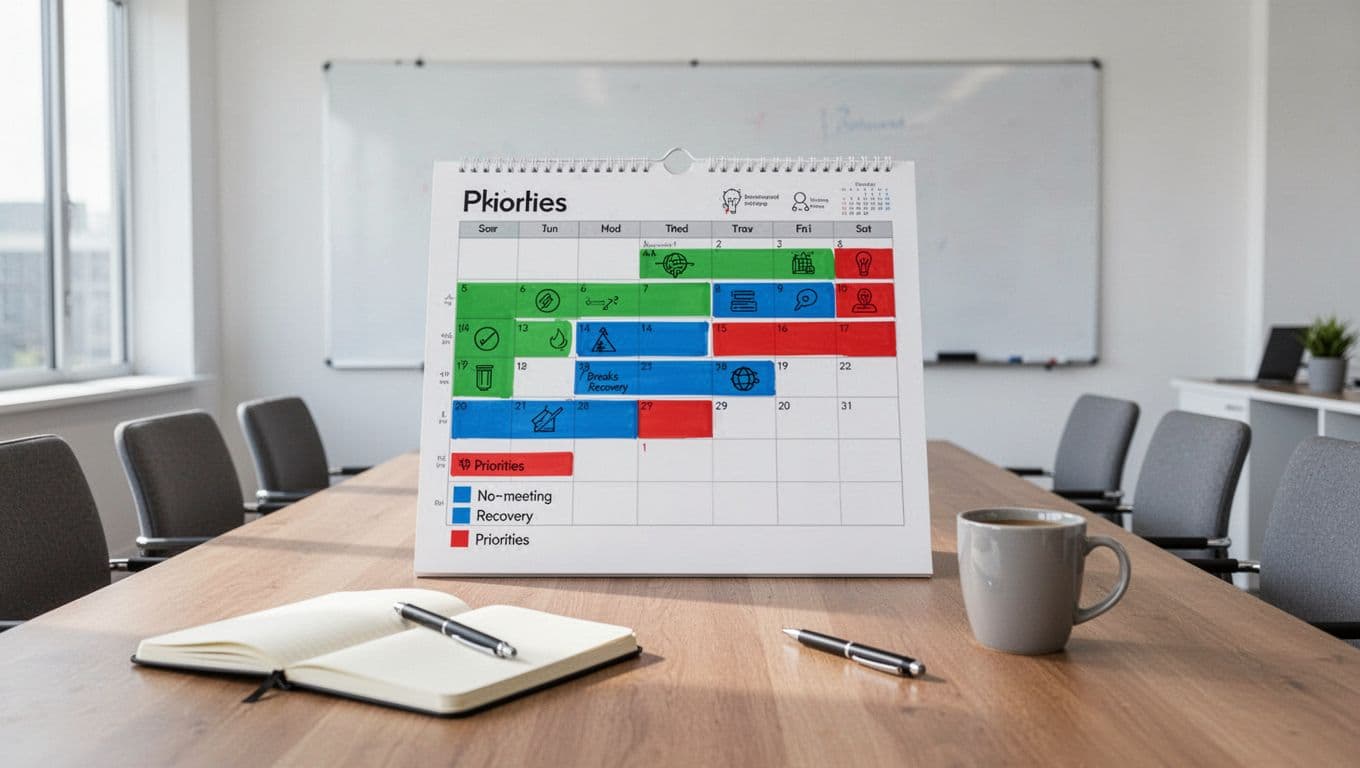
Time-blocking that protects focus and recovery, created with AI.
This doesn't need a massive initiative. It needs sponsorship and a tight pilot.
Put one owner on it (People Ops, HR, or the COO). Start with one leadership team for 30 days. Then expand only after you see what changed.
Week 1, measure the pressure and pick the top two causes to fix
Keep the assessment lightweight, but real.
Run a short anonymous pulse survey. Hold two listening sessions with a neutral facilitator. Then review simple operational signals: weekly meeting hours, after-hours messages, PTO usage, and top sources of rework.
Say the quiet part out loud: honesty is safe. No retaliation. No naming and shaming.
End week 1 by choosing the top two drivers to fix first. For many teams it's meeting overload and unclear priorities. Don't pick five. Pick two. Finish them.
Weeks 2 to 4, change daily habits and team rules (hours, meetings, recovery)
This is where prevention becomes visible.
Cut recurring meetings by default. Add no-meeting focus blocks. Clarify decision rights so everything doesn't climb the ladder. Normalize real delegation, not just task dumping.
Then set clean boundaries: fewer after-hours pings, protected lunch windows, and a rule that "urgent" needs a reason. Encourage full PTO use, and backfill it like you mean it.
Role modeling matters. Leaders go first, or nobody believes it.
If you want leaders to sound credible about stress, give them language that doesn't feel fake. This internal post helps with practical framing: Practical stress management responses for job interviews.
How to prove ROI without invading privacy
If you measure nothing, the program becomes vibes. If you measure everything, people stop trusting you.
Track a few indicators. Review them monthly. Keep reporting anonymized and aggregated.
Here's a simple scorecard that won't scare legal or your leaders:
| What to track (simple) | Why it matters | Review cadence |
|---|---|---|
| Weekly meeting hours (avg) | Predicts focus loss and overload | Monthly |
| After-hours message rate | Shows boundary health in practice | Monthly |
| PTO taken (by level) | Signals whether recovery is real | Quarterly |
| Short self-report stress check-in (anonymous) | Early warning, not a diagnosis | Monthly |
The takeaway: you're looking for load reduction and steadier execution, not perfect feelings.
Track leading indicators, meeting load, after hours work, and recovery
Leading indicators move before turnover does. That's the point.
If meeting hours drop and decisions speed up, you'll feel it in cycle time. If after-hours messaging falls, you'll see fewer "always on" norms. When PTO usage rises, burnout risk often drops, because recovery finally exists.
Keep it boring. Boring is good. Boring means it's working.
Use anonymized wellbeing data and practical tools like Pausa Business for scale
Programs scale when they require zero training and protect privacy.
That's where a licensed tool can help. With Pausa Business, a company provides app access across the team, leaders and individual contributors included. People can use short guided sessions from day one. Mood-guided recommendations can help them choose a session that fits the moment, and streaks support consistency without turning it into a public contest. Admin reporting can stay aggregated, so you can see adoption without peeking into personal data.
Conclusion
Leadership burnout prevention programs protect performance because they protect capacity. That means better decisions, stronger retention, and a culture that doesn't run on exhaustion.
Keep it simple:
- Spot signals early, before quality drops.
- Fix workload and norms, so the job fits the day.
- Support leaders with quick tools and light measurement, month after month.
Run a 30-day pilot. Make one or two work-design changes. Then add a practical breathing reset option like Pausa, and scale it with Pausa Business if adoption stays strong.