How CEOs Set Healthy Work Norms That Actually Stick
Andy Nadal
Author
Stress at work isn't abstract. It shows up as sloppy decisions, short tempers, rework, and quiet quitting. Then it shows up as churn. In 2026, plenty of CEOs ...
Stress at work isn't abstract. It shows up as sloppy decisions, short tempers, rework, and quiet quitting. Then it shows up as churn.
In 2026, plenty of CEOs still model always-on behavior. Late-night pings. "Quick calls" that eat dinner. Vacation that isn't real vacation. You can call it commitment, but the team reads it as policy.
This is a practical playbook for setting healthy work norms that hold under pressure. What to model. What to write down. What to measure. No slogans.
Model the culture you want, because your calendar is the real policy

Photo by Tima Miroshnichenko
Your CEO behavior sets defaults. That's always been true. Hybrid work just removed the social buffer that used to soften it.
People copy what you do, not what you announce.
If you answer Slack at 10:47 pm, your "we respect boundaries" line becomes fiction. If you praise the person who never disconnects, your burnout problem becomes an incentive system.
This matters because leadership burnout is not rare anymore. Recent reporting and surveys in the US keep pointing to high CEO burnout and rising turnover at the top, which is why more boards are treating it as a governance issue, not a personal weakness. See why burnout is a boardroom priority in 2026.
Run a blunt self-audit for two weeks:
- What time do you send messages?
- How do you react when someone takes PTO during a busy week?
- How often do you cancel your own breaks "just this once"?
- Do you praise hero hours, or outcomes?
- When a leader says "I'm overloaded," do you fix load, or give a pep talk?
Your calendar is a broadcast. Your reactions are training data.

An executive calendar built around priorities and protected breaks, created with AI.
Stop rewarding "always on" behavior with praise and promotions
"Hard worker" is a lazy compliment. It often means: available at all times, absorbs chaos, hides overload, and burns out quietly.
Praise different signals:
- Clear priorities, even when the quarter gets loud.
- Fewer handoffs, better handovers.
- Decisions made early, with the right people.
- Sustainable delivery, not heroic recovery.
Promote managers who protect their teams and still hit goals. That's the job. Anything else is theater.
Use a simple script in your next all-hands. Say it once. Then repeat it until it's boring:
"We do great work without 10 pm emails. If something is urgent, we'll label it urgent. Everything else can wait."
Then match it with action. If someone sends a late-night note, don't compliment dedication. Ask what failed upstream: planning, staffing, scope, or clarity.
For more CEO-level framing on reducing workplace stress, skim practical stress-reduction moves CEOs can make. Treat it as a reminder, not a manifesto.
Make boundaries visible, set communication windows and protect offline time
Boundaries that live in someone's head don't scale. You need norms that are visible and easy to follow.
Start with communication windows and response expectations by channel. One sentence per channel beats a long policy nobody reads.
Here's a simple baseline many US teams can run with:
| Channel | Use for | Expected response time | After-hours rule |
|---|---|---|---|
| Non-urgent updates, decisions that can wait | Next business day | Don't expect replies | |
| Chat (Slack/Teams) | Same-day coordination | 2 to 4 working hours | Use scheduled send |
| Call/Text | True urgency only | ASAP | Must be labeled urgent |
The point is not control. It's predictability.
Next, protect offline time. No after-hours email expectation unless it's genuinely urgent. Add meeting-free blocks for deep work, then defend them like revenue. If you try a no-meeting day, leadership has to follow it too. Otherwise it becomes a day where managers still schedule "exceptions."
Also, don't confuse "fewer days" with "less load." If you compress work without cutting scope, you just create a stress microwave.
For a broader view of how CEO priorities are shifting in 2026, including culture and workforce strain, see HR Executive's take on CEO priorities.
Write down a few clear rules, then make it easy for people to follow them
Healthy work norms should fit on one page. Two pages, max. Not a handbook. Not a PDF graveyard.
Call it "Working Norms." Keep it plain:
- What matters most this quarter.
- How decisions get made.
- What "good" looks like.
- How to ask for help when overloaded.
- What happens when priorities conflict.
Clarity reduces anxiety because it reduces guessing. Guessing is where people spin at night.
A tight one-pager also gives managers cover. They can point to it when they push back on scope, meeting sprawl, or last-minute fire drills. That's important because most burnout doesn't come from one big event. It comes from constant small collisions.
If you already use OKRs, good. If you don't, you still need the principle: limit work in progress. Too many "top priorities" is how you get nothing done and everyone exhausted.
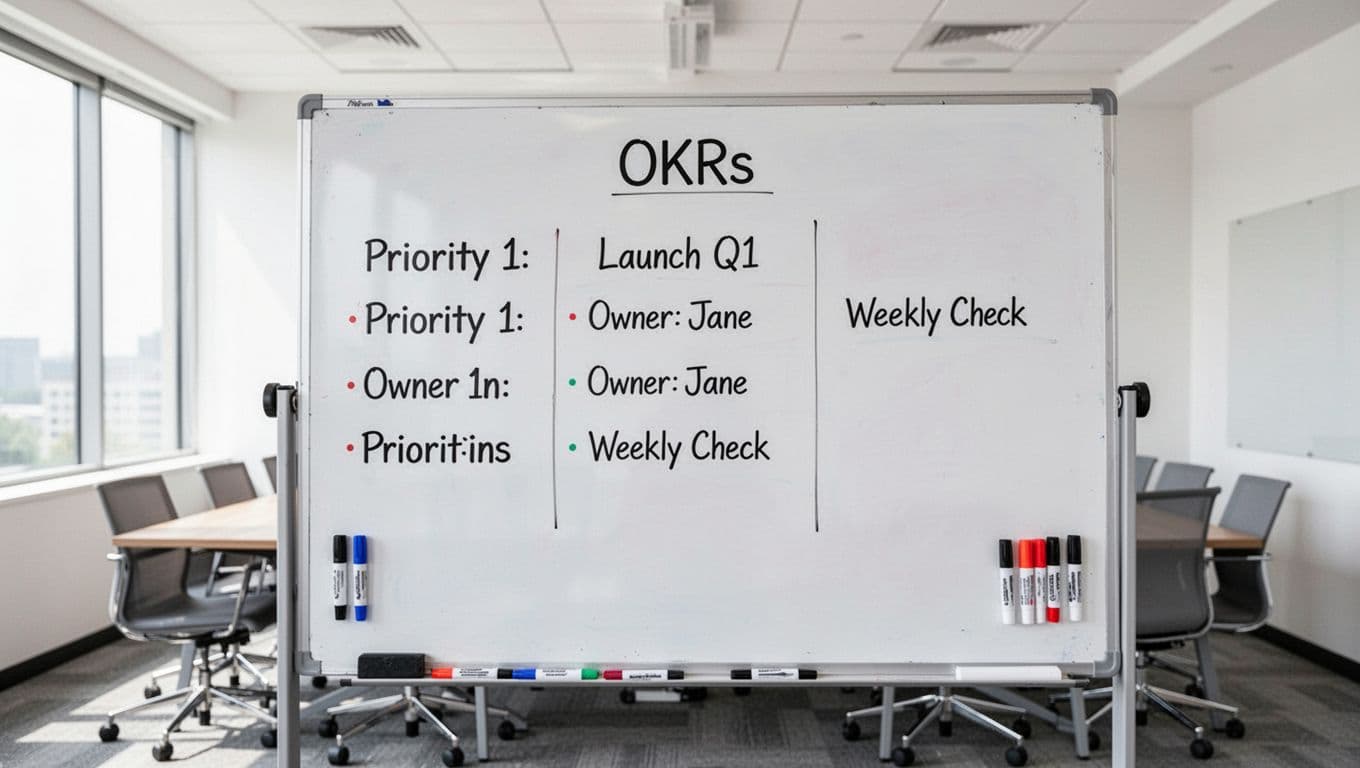
Simple priorities with owners and check-ins, created with AI.
Use priorities to prevent overload, limit projects, and say no faster
Most teams don't need more hustle. They need fewer open loops.
Keep it simple:
- Pick 3 to 4 company priorities for the quarter.
- Assign one accountable owner per priority.
- Run weekly check-ins that surface overload early.
This is not bureaucracy. It's load management.
In practice, the weekly check-in is where you catch the real issue: the same "high performer" is doing three jobs because nobody else is staffed, trained, or trusted. Fix that, and you fix your work norms.
One warning matters more than the rest: flexibility without workload reduction can backfire. If you give people "freedom" but keep the same scope, the work just spills into nights and weekends. The company feels modern. The employee feels trapped.
If you want data-backed context on what burnout is costing workers and what employers are trying in 2026, read Stacker's roundup of burnout strategies. Then choose the few moves you can execute, not the dozen you can announce.
Fix meetings first, one company rule can give hours back each week
Meetings are where healthy norms go to die. Not because meetings are evil, but because they're the easiest place to hide poor thinking.
A meeting reset can return real time in week one. Try one company rule: meetings default to 25 or 50 minutes. Not 30 or 60. That small constraint forces sharper agendas.
A practical checklist that works:
- Every meeting needs a one-line goal and a short agenda.
- Invite fewer people, then share notes widely.
- Push updates async, keep meetings for decisions.
- Protect one half-day each week with no internal meetings.
Your role as CEO is simple: decline meetings that could be an async update. Do it publicly. When your assistant asks why, give the reason in plain language: "No agenda, no meeting."
Then celebrate the outcome, not the reduction. Fewer meetings only matter if execution stays strong.
Build a stress-safe workplace, support mental health, and measure adoption not slogans
A stress-safe workplace isn't a feelings workshop. It's an operating system where people can speak early, recover fast, and keep going.
That starts with psychological safety. Not "we're a family." Just the basics:
- People can raise risks without punishment.
- Managers don't punish bad news.
- Workload conversations are normal, not shameful.
Manager behavior is a force multiplier. One bad manager can wreck a whole function. One good manager can absorb chaos without exporting it to their team.
Wellness programs often fail for a boring reason: they create friction. They require training. They feel like homework. Or they feel like performance, which turns people off.
What works better is small, repeatable habits. Two to five minutes. Built into the day. No big identity shift required.
A key measurement shift also matters: measure adoption, not applause. If the tool isn't used, it doesn't exist.
Give people fast relief tools, make healthy pauses part of the workday
Not everyone meditates. Everyone breathes.
That's why guided breathing is a strong entry point for teams that want relief without a long learning curve. Short sessions can help people move out of stress physiology and back into focus. It's not magic. It's regulation.
Pausa was built from a simple insight earned the hard way: panic attacks make your world small. Breathing can make it wider again. The app focuses on guided breathwork that fits real workdays, plus features that nudge lower screen time and more intentional breaks. When people feel alone in stress, a calm guide in their ear can be enough to interrupt the spiral.
If you want a simple place to start, point your team to the Pausa guided breathing app. It's built for people who want quick help, not a new hobby.
Small pauses don't look impressive. That's the point. They still change the day.
Offer a program that gets real use, with simple rollout and anonymized insights
If you're a CEO buying wellbeing support, your real question is blunt: will anyone use it?
Pausa Business is designed to reduce the usual barriers. Setup takes minutes. Colleagues download the app on iOS or Android. Guided breathing works from day one, with zero training.
Adoption comes from product choices that respect attention:
- Mood-based recommendations that match stress, focus, energy, or calm.
- Smart screen-time locks that interrupt doom-scrolling and redirect to breathing.
- A short learning journey (10 days) that builds competence fast.
- Streaks that make habits social, not preachy.
On the employer side, privacy has to be non-negotiable. Pausa Business uses fully anonymized reporting, so leaders can see engagement trends without turning wellbeing into surveillance.
Pricing stays straightforward too: plans start around $2 per employee per month or $18 per employee per year. That's low enough to run a real pilot, then scale if usage proves it.
For CEOs thinking about automating health habits at the leadership level, this framing aligns with healthy habits leaders are trying to automate in 2026. The throughline is simple: remove friction, or nothing sticks.

A team normalizing short breathing breaks during the workday, created with AI.
Conclusion: Model it, codify it, enable it
Healthy work norms don't come from a memo. They come from what you reward, what you make easy, and what you refuse to normalize.
Use three levers: model it (your calendar), codify it (one-page working norms), enable it (tools people actually use).
A clean 30-day plan:
- Week 1: audit your calendar and communication patterns, then set channel response norms.
- Week 2: reset meetings (25/50 minutes, agenda required, protect a no-meeting block).
- Week 3: limit priorities, cut work in progress, delegate ownership with real authority.
- Week 4: roll out a wellbeing tool, then run a quick pulse check on stress and focus.
Small pauses compound. So do small bad signals. Choose what you want to multiply, then act like you mean it.