Founder Burnout Recovery Plan: A 14-Day Reset That Protects You and the Company
Andy Nadal
Author
If you're a founder who can't think straight, can't sleep, and can't stop pushing, you don't need motivation. You need recovery . Founder burnout doesn't alw...
If you're a founder who can't think straight, can't sleep, and can't stop pushing, you don't need motivation. You need recovery.
Founder burnout doesn't always look dramatic. It looks like brain fog during a board call. A short temper in Slack. No joy, even after a win. Waking up at 3:00 AM with your chest tight. Decision fatigue that turns simple choices into slow misery.
In February 2026, this is not rare. One recent US-focused write-up cites severe burnout in roughly two-thirds of startup CEOs this year, a number that matches what many investors and operators quietly admit in private (2026 founder burnout stat and context).
This is a practical founder burnout recovery plan. Not a vibe. Not a retreat fantasy. A two-week reset that steadies your nervous system, reduces damage, and makes the business easier to run. It also uses small pauses and simple breathing, because your body can't think its way out of stress.
First, confirm it is burnout (and spot the business risks early)
 An exhausted founder in a late-night work loop, created with AI.
Normal stress says, "This is hard." Burnout says, "I can't recover from hard."
Stress spikes and then fades. Burnout sticks. You sleep, but you don't recharge. You ship, but you don't feel relief. Even good news lands flat. That's the tell.
Founders miss it because burnout looks like commitment at first. Long hours. High output. "Just one more sprint." Then the costs show up in the places you can't hide:
- You make slower calls, or you make reckless ones.
- You miss details, then spend days fixing preventable mistakes.
- Your tone gets sharp, and your best people start scanning LinkedIn.
- Fundraising gets harder because you can't project calm control.
This isn't fear talk. It's systems talk. Your state becomes the company's weather.
Also, burnout rarely stays personal. It turns into cofounder conflict, culture drift, and execution wobble. Plenty of startups don't fail from product, they fail from leadership collapse. Early action is cheaper than cleanup.
For a useful outside mirror, this piece explains how teams often notice founder burnout before the founder does (how employees detect founder burnout).
The most common red flags founders ignore
Burnout signs don't arrive as a neat checklist. They arrive as "normal" days that feel wrong.
Look for these patterns:
- You're exhausted all day, then wired at night.
- Cynicism creeps in. Everything feels stupid or pointless.
- You feel numb, even when things go well.
- Headaches, jaw tension, gut issues, constant tightness.
- You wake up at 3:00 AM and start solving problems in your head.
- Anxiety spikes before meetings, pitches, or hard conversations.
- You avoid tasks you used to handle fast.
- You snap at people, then justify it as "standards."
- Caffeine keeps rising. Alcohol becomes a switch you rely on.
- Focus slips, and decisions drag.
Quick self-check: If your calendar is full but your energy is empty, pay attention.
If you want a second reference point for typical startup patterns, this overview is straightforward (founder burnout red flags).
When to get professional support right away
Some signals mean you don't "power through." You get support.
If you've had panic attacks, persistent depression, escalating substance use, or any thoughts of self-harm, talk to a licensed mental health professional. If you already have a clinician, tell them the truth, not the polished version.
Evidence-based care matters here. Many high-stress leaders do well with structured approaches like CBT because it targets thoughts, behaviors, and coping loops without turning your life into a confession booth.
This article is not medical advice. It's a push to take the situation seriously. A company can recover from a rough quarter. It may not recover from losing you.
The 14-day founder burnout recovery plan (stabilize your body, then your workload)
Burnout recovery is not a vacation you earn after you "finish the work." It's maintenance. Like patching a security hole. Like paying taxes. Like replacing brakes before the crash.
The order matters:
- Stabilize the body (sleep, nervous system, basic rhythm).
- Stabilize the workload (triage, fewer decisions, fewer inputs).
- Then redesign the week so you don't slide back.
This plan assumes you're still running the company. It aims for minimum effective dose. Small actions, done daily, that change the state of your system.
Days 1 to 3, stop the spiral and get one good night of sleep
Your goal for the first 72 hours is simple: stop adding fuel.
Start with calendar triage. Cancel or move anything that isn't urgent and high-impact. Keep only revenue, retention, and "team is on fire" meetings. Everything else can wait.
Next, reduce decision load. No new projects. No new hires unless critical. No "maybe we should also…" ideas. Write them down, park them for Day 11.
Then set a hard stop time. Pick one and keep it boring. If you work until midnight, your body learns midnight. It will keep waking you there.
Add two sleep guardrails:
- Caffeine cutoff at least 8 hours before bed.
- A simple wind-down (shower, low light, paper book, or quiet music).
Now the fast nervous system reset: a 5-minute breathing break protocol, three times a day.
- Before high-stakes meetings.
- After conflict.
- Before sleep.
You don't need a 30-minute meditation habit. You need a lever you can pull on demand. Somatic clinicians often describe breath as one of the quickest routes into downshifting a stressed system (breathing when you're burnt out).
If you want guided support that's built for real life (short sessions, no spiritual theater), use Pausa. It was created after panic attacks, with a simple premise: you don't need to "learn to meditate," you need to breathe on purpose. It's designed to help with stress, anxiety, sleep, and reducing screen time, especially when you're fried.
The first win isn't "getting back to normal."
It's getting one night where your body actually powers down.
Days 4 to 10, rebuild your capacity with small routines that stick
At this stage, you're not chasing peak performance. You're rebuilding baseline capacity.
Pick 3 routines and repeat them. No heroics.
First, a morning light walk. Ten to twenty minutes outside, soon after waking. It's simple, and it helps anchor your day. Keep it phone-free if you can. If you can't, at least don't open email.
Second, one protected deep work block. Ninety minutes is enough. Close Slack. Close the inbox. Work on the one thing that makes the company sturdier.
Third, food and hydration basics. Eat something with protein early. Drink water before your second coffee. Burnout loves blood sugar chaos.
Now add breathing tied to triggers, not "free time." For example:
- After a hard customer call.
- Right before a pitch.
- Right after you send a difficult email.
Use approachable patterns like box breathing or resonant breathing. Pausa includes both, plus more intense options (including Wim Hof-style breathing). If you're curious about the Wim Hof approach in a burnout context, this overview explains the basics and precautions (Wim Hof Method burnout recovery page).
Finally, do a daily 30-second mood check-in. One word is enough: tense, flat, angry, foggy, okay. After a week, you'll see patterns. Certain meetings spike stress. Certain people drain you. That data is gold.
Days 11 to 14, redesign your week so burnout does not return
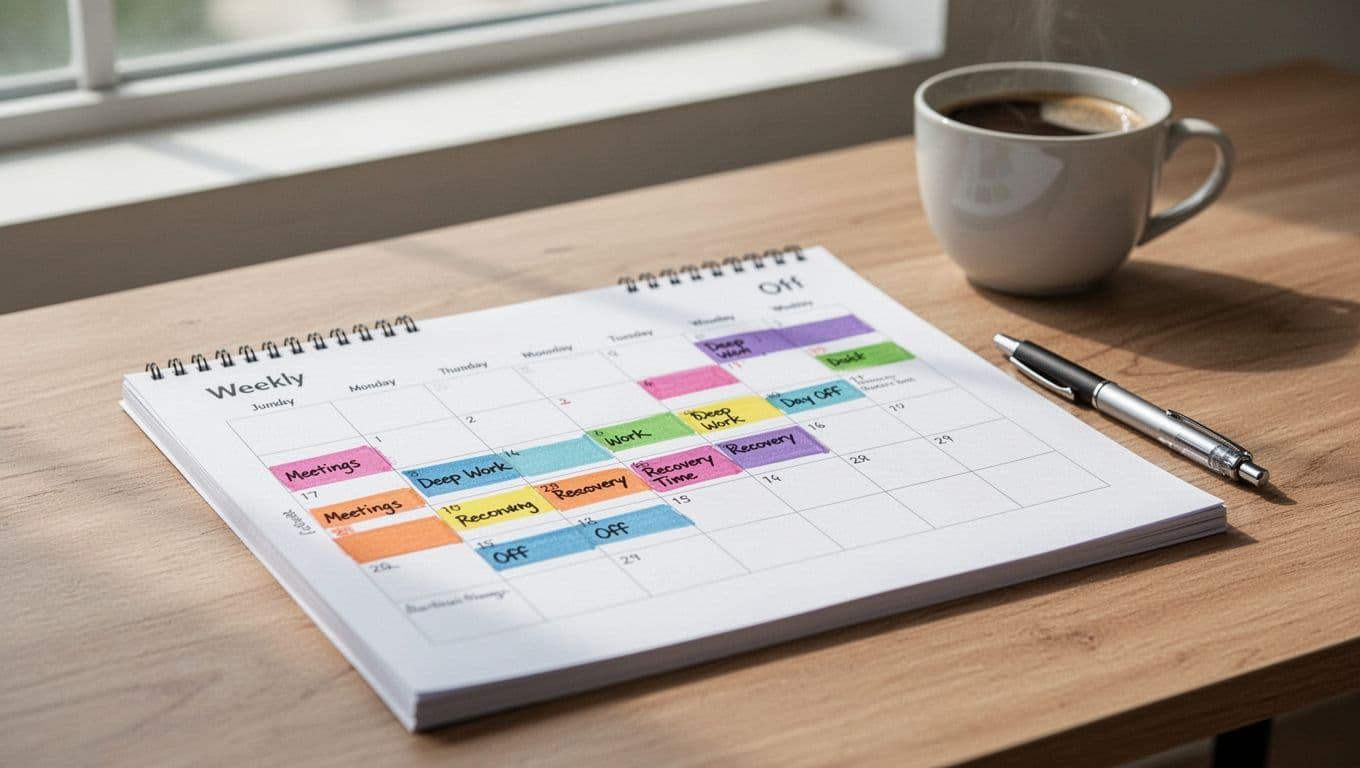 A weekly plan that includes recovery blocks, created with AI.
Burnout returns when your week has no recovery built in. Not "self-care," just recovery, like any other operating constraint.
Make these changes non-negotiable:
- Cap meetings per day. If you can't cap count, cap hours.
- Add a no-meeting half-day each week.
- Schedule one daily recovery block (15 to 30 minutes). Put it between demanding calls.
- Keep one real day off weekly. Real means no "quick check" of Slack.
Use one blunt rule for the next month: If it's not revenue, retention, or team health, delay it. Delay is not denial. It's sequencing.
Also reduce screen time friction. Endless scrolling keeps your nervous system in input mode. Less input makes it easier to sleep, focus, and regulate. If your phone is your pacifier, you're paying with your brain.
Fix the root causes, delegate, decide, and lead without burning out again
Burnout is personal, but it's also structural. If your company requires you to be the CPU for every process, you will melt.
The trap is "doing more." More hours. More grit. More caffeine. That's not leadership, it's a slow leak.
Instead, upgrade your operating system:
- Delegate earlier than feels comfortable.
- Reduce the number of daily decisions.
- Replace improvisation with simple rules.
- Stop treating isolation as a badge.
Rest also improves performance in the most founder-specific way: it sharpens judgment. During fundraising, that matters. Pitch quality drops when you're exhausted, even if the deck is perfect.
And yes, burnout spreads. Your state sets the tone. If you're frantic, the org becomes jumpy. If you're steady, execution smooths out.
A simple workload triage, stop doing, start delegating, keep only what you must own
Start with a list of your top 10 weekly tasks. Then mark only the ones that truly require founder judgment. Be ruthless.
Everything else gets one of three outcomes: delegate, pause, or automate.
If you need examples of what founders should hand off first, this is a practical breakdown (tasks founders should delegate first).
Use simple delegation scripts that don't create ambiguity:
- "I'm handing you ownership of X. Success looks like Y by Friday."
- "Make the call, then send me a 3-bullet summary and your recommendation."
- "If the decision is under $1,000, decide without me."
Add decision hygiene. Limit big decisions per day. Batch approvals into one block. Decision fatigue is real, and you're not immune because you have equity.
Build a team check-in that protects you and them
 A calm team check-in that keeps work sustainable, created with AI.
You don't need a new committee. You need a light loop.
Run a weekly 15-minute leadership health check. Not therapy. Signal detection. Ask:
- "Where did we feel rushed this week?"
- "What broke because we moved too fast?"
- "Did I show up inconsistent or hard to reach?"
Give your team permission to flag it early. They already see it. Formalizing it reduces anxiety and turnover.
At the company level, use privacy-respecting data. The principle matters: track engagement and trends without exposing individuals. Anonymized reporting keeps trust intact while still showing whether support is actually used.
Turn your recovery into a company-wide burnout prevention program
 A short breathing break in the middle of a workday, created with AI.
Most wellness tools fail for a boring reason: they demand time, training, or belief. People ignore them, then leaders claim "wellness doesn't work."
Low-friction practices win. Breathing is a good entry point because everyone already breathes, and it doesn't require meditation experience. It also fits inside real workdays, which is the only place it counts.
Pausa Business is built around that idea. The company buys access, employees download the app on iOS or Android, and they use short guided breathing sessions to reduce stress and anxiety from day one. The goal is adoption, not applause.
Pricing is simple, with plans starting around $2 per employee per month, plus an annual option (often positioned around $18 per employee per year). The start is low-commitment, with a "no card required, cancel anytime" posture, because forcing a long contract doesn't fix stress.
What to look for in a burnout tool your team will actually use
If you're buying for outcomes, filter hard:
- Easy onboarding: people should start in minutes.
- No training required: nobody wants a webinar.
- Short sessions: five minutes beats thirty.
- Works mid-day: right before conflict, right after bad news.
- Sleep support: because sleep is the foundation.
- Privacy respect: program insights, not personal exposure.
- Engagement visibility: leaders need signals, not guesses.
Also check device support, because friction kills adoption. For teams evaluating rollout details, see the supported iOS and Android versions for Pausa.
How Pausa Business supports wellbeing without adding more work
Rollout can be simple:
- Buy licenses.
- Invite the team.
- Normalize three breathing moments: start of day, after tough meetings, end of day.
The product design stays practical. Instead of begging for attention, it can interrupt unhelpful screen time and nudge a breathing pause. Instead of generic content, it can recommend techniques based on mood. Instead of asking for discipline, it offers a short guided journey that builds the habit. Streaks help consistency without turning it into a contest.
On the admin side, leaders can manage licenses centrally and monitor engagement and wellness reporting at a high level (not individual callouts). If you want a concrete example of an admin hub, Pausa provides an organization admin panel for license management and program-level insights.
The point is not to "do wellness." The point is to lower stress enough that people think clearly, work cleanly, and go home less wrecked.
Conclusion
Founder burnout doesn't get fixed by toughness. It gets fixed by design.
Confirm it early. Stabilize in 14 days. Fix the root causes in your workload. Then scale prevention to the team with low-friction support that people actually use. Small pauses and conscious breathing can shift stress into calm, even when the calendar is ugly.
Pick one action today: set a sleep boundary, delegate one task, or take one 5-minute breathing pause before your next meeting. Then repeat it tomorrow. That's recovery.