Best Breathing App for Workplace Stress (2026 Guide for CEOs)
Andy Nadal
Author
Back-to-back meetings. Slack pings stacking up. A tight chest that shows up right when you need a clean decision. Workplace stress isn't abstract. It turns in...
Back-to-back meetings. Slack pings stacking up. A tight chest that shows up right when you need a clean decision.
Workplace stress isn't abstract. It turns into rework, missed details, short tempers, and people quietly checking out. Then churn follows. And the cost lands on the business, not just the person.
Recent 2025 to 2026 US survey data puts burnout risk above 80% for many workers, and broad estimates place annual productivity losses from stress in the hundreds of billions of dollars. That's not a "wellness" problem. It's an operating problem.
This guide gives you a simple way to pick the best breathing app for workplace stress, plus a practical shortlist of top options for 2026. You'll also get a rollout plan that doesn't require training, preaching, or a culture rewrite.

Photo by Brett Jordan
What makes a breathing app the best choice for workplace stress (not just a nice idea)
 An office worker taking a short breathing pause at their desk, created with AI.
A breathing app wins at work for one reason: it can change state fast.
Not "transform your life." Not "unlock your potential." Just shift someone from spun-up to steady in 1 to 5 minutes, so the next email isn't written like a threat.
Most workplace stress interventions fail because they assume extra time, extra focus, and extra motivation. People don't have that at 2:17 pm, right after a tense call, with six decisions left.
So the best breathing app for workplace stress is the one that fits the real moments:
- Before a hard conversation, when your body goes into defense.
- After conflict, when your mind keeps replaying the scene.
- During decision fatigue, when everything feels urgent and nothing feels clear.
- At shutdown, when work follows you home.
It also has to pass a harsh test. Adoption. If your team doesn't use it, it doesn't exist.
The must haves for busy teams: fast sessions, zero learning curve, and the right exercise for the moment
Speed matters because stress shows up as physiology first. Heart rate up. Breathing shallow. Muscles tight. A good app treats that like a system alarm, not a moral failure.
Look for short, guided sessions (audio helps). Reading instructions while stressed is like trying to debug code during an outage. People need a voice, a timer, and a pattern.
The patterns should be familiar and practical:
- Box breathing: useful before presentations, negotiations, and high-stakes calls. It's structured, easy to follow, and tends to stabilize attention.
- Resonant breathing (slow, steady cadence): good for downshifting after conflict or when the day feels chaotic.
- Physiological sigh (double inhale, long exhale): best when someone feels "tight chest" stress and needs quick relief without a full session.
The key point for teams: employees don't need to meditate to benefit. They don't need belief. They don't need quiet lighting. Everyone breathes, so everyone can start.
For context on how short digital breathing interventions can be evaluated in daily stress conditions, see this research summary in npj Digital Medicine on digital breathing interventions for daily stress.
Features that drive real adoption at work: mood check ins, habit streaks, and less doomscrolling
Once the app "works," you still have a usage problem. People forget. They default to scrolling. They postpone the reset until later, then later never comes.
That's where the right features matter, not as gimmicks, but as friction reducers:
Mood check-ins help people name the state fast. Stressed. Wired. Flat. Distracted. Then the app can recommend a fitting session for stress, focus, energy, or calm. That beats browsing a library while your brain is already overloaded.
Habit mechanics also matter in a workplace context. Streaks can help, not because streaks are magical, but because they make consistency visible. A short guided path (like a 10-day beginner journey) helps people get past the "I don't know what I'm doing" phase.
Finally, consider "anti-doomscrolling" design. Gentle screen-time interrupts or soft locks can redirect autopilot phone use into a breathing break. Done right, it's not punishment. It's focus protection.
Adoption isn't a vibe. It's design: fewer steps, fewer choices, faster payoff.
Best breathing apps for workplace stress in 2026: a simple shortlist and who each one fits
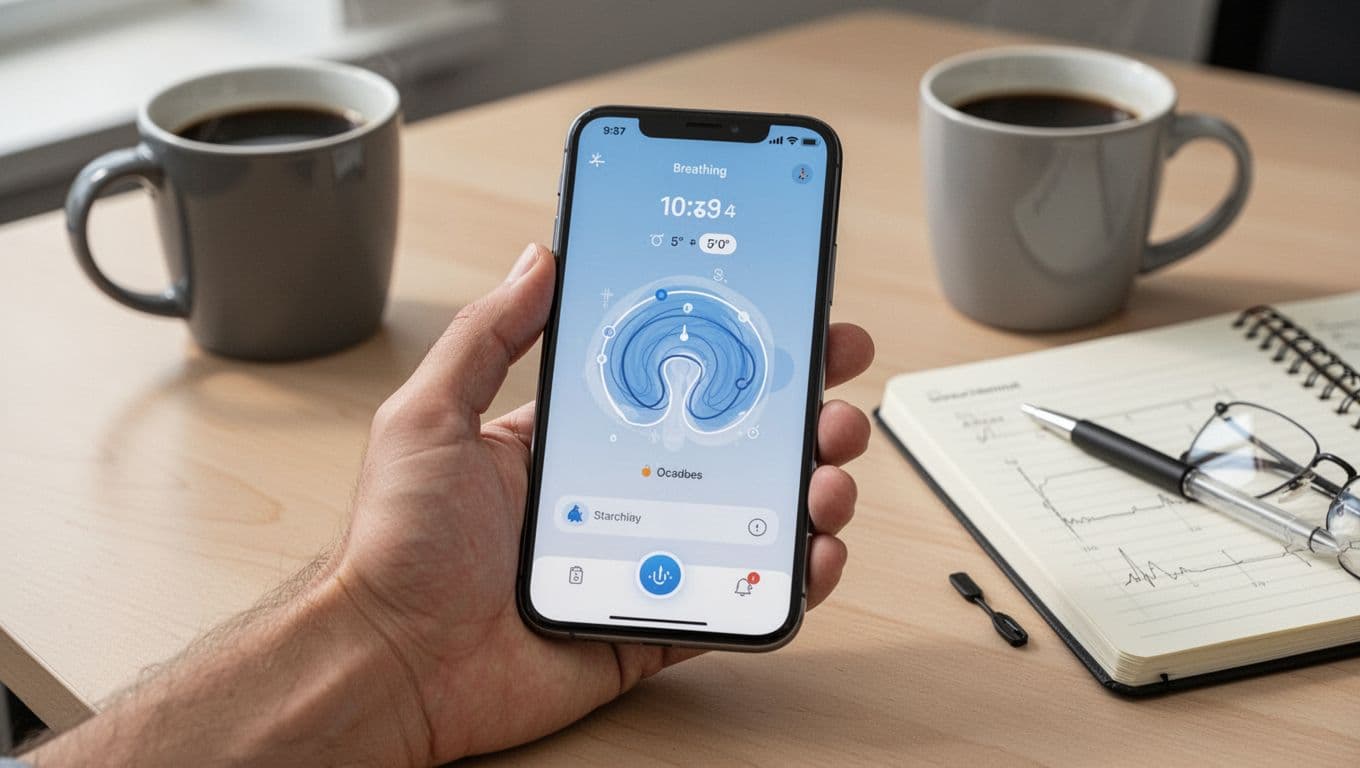 A simple breathing app being used at a work desk, created with AI.
There isn't one perfect app. There is the right fit for your time constraints, culture, and tolerance for "extra stuff."
Here's a CEO-friendly shortlist based on real workplace use cases:
- Pausa: best for short, guided "pause" moments and low-friction adoption.
- Calm: best if your org wants an all-in-one wellness library (sleep, mindfulness, soundscapes) and employees will browse.
- Breathe2Relax: best for a no-frills, skills-based approach that feels more clinical and structured.
- Breathwrk: best for breathwork-first variety and quick sessions if your team already likes breathwork.
- Prana Breath: best for people who like breathing timers, pacing, and tracking, with a more "trainer" feel.
If you want a broader consumer-style roundup to sanity check your shortlist, this breathing app comparison list for 2026 can help you see how different apps position themselves.
Quick comparison for leaders: which app works best for your culture and constraints
Use this table like a filter. You're not buying features. You're buying repeat usage.
| Filter | What to ask | Why it matters at work |
|---|---|---|
| Time to first benefit | Can someone feel better in 2 minutes? | People won't wait for payoff between meetings |
| Simplicity | Can a stressed person use it instantly? | Stress reduces working memory and patience |
| Distractions | Does the app push you to browse? | Browsing kills usage in high-load weeks |
| Personalization | Does it recommend the right session fast? | Choosing wrong makes people quit |
| Team readiness | Can you roll it out with minimal admin? | Programs fail when setup becomes a project |
Broad wellness apps can be great, but they can also feel busy. Breathwork-first apps often win on speed and clarity.
If you want evidence that digital tools can reduce stress and burnout symptoms in working adults, this npj Digital Medicine paper on a randomized stress and burnout digital therapeutic is useful background. The takeaway is simple: well-designed, self-guided tools can work, but only if people actually use them.
Why Pausa stands out for workplace stress: built for short pauses, not long routines
Pausa is built around a blunt truth: most people won't adopt long routines at work. They will, however, take a short pause when it's obviously helpful.
It focuses on guided breathing that works from day one. No ceremony. No required meditation background. Just practical patterns (including box and resonant breathing) for moments like pre-meeting nerves, post-conflict heat, and end-of-day shutdown.
It also leans into adoption drivers that matter at work:
- AI-powered mood tracking that learns what someone reports, then suggests a fitting session for calm, focus, or energy.
- A 10-day journey that turns "I don't know how to breathe right" into competence fast.
- Streaks that make consistency visible, without turning wellbeing into a performance.
- Smart screen-time locks that interrupt mindless scrolling and redirect attention into a breathing moment.
Halfway through the day is often when stress spikes, which is why a simple download matters more than another policy memo: https://pausaapp.com/en.
Pausa is available on iOS and Android. It's also designed for people who feel alone in the stress loop. The guidance feels like companionship, not a lecture. That philosophy isn't accidental. The product grew out of real panic attacks and the search for something that helps in the moment, not someday.
For leaders comparing "breathing" vs "mindfulness" app approaches, JMIR offers helpful context on outcomes studied in working populations, including this trial on app-based mindfulness and mental health.
How to roll out a breathing app at work so employees actually use it
 A team starting a meeting with a short breathing reset, created with AI.
Buying access is easy. Getting behavior change is the work.
The rollout should feel like a tool rollout, not a wellness campaign. Keep it light. Keep it optional. Tie it to moments that already exist.
Also, don't create a surveillance fear cloud. If you're collecting anything at the org level, prefer anonymized reporting and communicate that clearly. People won't breathe if they think it becomes a metric on their performance review.
Measurement should be simple and boring:
- Engagement (activations, repeats, week-to-week usage)
- Self-reported stress or focus (short pulse checks)
- Operational signals (errors, escalations, unplanned rework, sick days), if you already track them
The goal isn't perfect attribution. It's directional proof: fewer stress spikes, faster recovery, better focus.
If you want a practical angle on how people describe stress control under pressure, this internal guide on how to answer "how do you manage stress" maps well to workplace behaviors leaders can model.
A simple 30 day launch plan: start small, pick key moments, and make it social but optional
Week 1: Pilot with one team you trust. Choose a team with high meeting load and a manager who will model the behavior. Keep the ask tiny: two minutes per day, three days a week.
Week 2: Invite the company. Don't oversell it. Use one line that frames it as performance hygiene: "Two minutes to reset your nervous system before the next decision."
Week 3: Add habit nudges tied to triggers. Pick 2 to 3:
- Pre-meeting reset (before the weekly leadership meeting)
- Post-conflict cooldown (after a hard customer call)
- Afternoon slump (2:30 pm calendar reminder for a 90-second breathe)
Week 4: Review and decide. Look at usage and one simple survey question: "Did this help you recover faster from stress at work?" If yes, scale. If not, change the tool or the triggers.
Manager modeling is the multiplier. A leader who says, "Let's take 60 seconds," gives permission without a speech.
Why Pausa Business works for teams: fast setup, anonymized insights, and pricing that scales
Pausa Business is built like an IT rollout, not a wellness retreat.
The flow stays simple:
- The company buys Pausa Business and sets up the organization in minutes.
- Colleagues download the app on iOS or Android.
- They start reducing stress and anxiety with guided breathing, with no training needed.
What leaders care about shows up in the outcomes: reduced perceived stress, improved focus during intense workdays, real adoption without onboarding sessions, and fully anonymized data.
Pricing is also straightforward. Plans start at $2 per employee per month or $18 per employee per year, which matters when you need to cover the whole workforce, not just a small "wellness" segment.
Admins also get centralized license management and engagement trends through an admin panel, without exposing personal data. If you want to evaluate it as a company-level program, start here: https://business.pausaapp.com/.
Conclusion
The best breathing app for workplace stress isn't the one with the longest feature list. It's the one people use when stress is actually happening.
Prioritize fast relief, low friction, and the right exercise for the moment. Then look for adoption drivers: mood-based recommendations, simple habit support, and design that protects focus instead of stealing it.
Most importantly, treat breathing like a small operational control loop. A short reset changes the next decision, the next email, the next conversation. Those moments compound.
Next step: pick one app, run a 30-day pilot, measure engagement and self-reported impact, then scale what works. Small pauses, real output.