A Practical Wellbeing Program Rollout Plan for HR and Leadership (2026)
Andy Nadal
Author
Burnout isn't a mood. It's a systems problem. And in early 2026, it's everywhere. Multiple US surveys keep landing in the same rough range: most workers repor...
Burnout isn't a mood. It's a systems problem. And in early 2026, it's everywhere.
Multiple US surveys keep landing in the same rough range: most workers report some level of burnout or high stress, and many say it hurts their performance and makes quitting feel more likely. The numbers shift by industry, but the direction doesn't. Stress is up. Trust is down. People feel stretched.
That's why a wellbeing program rollout plan can't be a perks dump. Most "wellness" perks fail for a simple reason: low adoption. If it's complicated, optional in name but judged in practice, or hidden behind HR portals, employees ignore it.
This post is a rollout plan HR and leaders can actually run. It's built around three moves: align on outcomes, design around real needs, then roll out in phases with measurement. Also, start simple. Short, guided breathing tools are a strong entry point because not everyone meditates, but everyone breathes.
For current context on burnout's cost and why employers are under pressure to act, see Spring Health's overview of the employer opportunity in the burnout crisis.
Start with the "why": align leaders on outcomes, budget, and guardrails
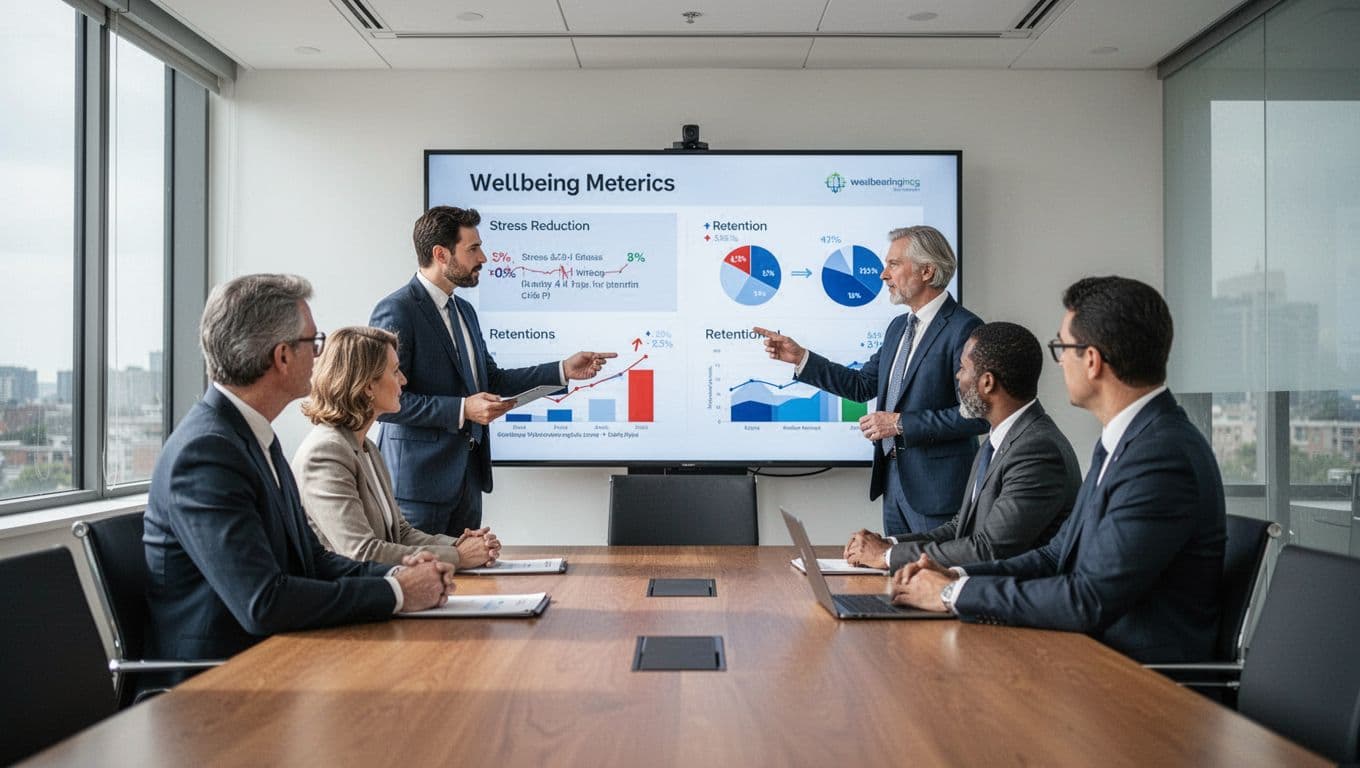
Leaders aligning on a simple wellbeing scorecard and review cadence, created with AI.
Your wellbeing program doesn't need a manifesto. It needs an operating definition.
Start by answering one question with your exec team: what problem are we solving, and what will change if we solve it? Keep it blunt. Examples that map to business reality:
- Reduced perceived stress across teams (not "more mindfulness").
- Improved focus during intense workdays (not "higher engagement vibes").
- Fewer mistakes and less rework (stress shows up as quality drift).
- Lower sick-day spikes during crunch periods.
- Better retention in high-stress roles.
Then set guardrails. Budget, time, and privacy expectations. If you skip guardrails, the program turns into a trust leak. People assume the worst. They opt out. Adoption dies quietly.
Leader behavior matters more than your vendor list. If leaders never use the tools, never mention them, or treat breaks as weakness, the program becomes theater. Managers take cues. Employees watch managers.
Psychological safety is part of the rollout, not a nice-to-have. That means employees must believe two things: they won't be punished for using support, and their data won't be used against them. For mental health programs, default to aggregated, anonymized reporting. No individual dashboards. No "who is stressed" lists.
 Photo by Antoni Shkraba Studio
Pick a small set of success metrics you can track in 90 days
More metrics won't make you smarter. It'll make you slower. Use a scorecard with 3 to 5 signals max, and review it every two weeks.
A clean 90-day set looks like this:
- Participation rate: percent of employees who activate the benefit.
- Repeat usage: percent who come back weekly (this matters more than launch-week hype).
- Pulse stress score: a 1-minute check-in, trend line only.
- Manager sentiment: short monthly prompt, "Are you seeing better recovery after high-stress moments?"
- Absenteeism trend (optional): directionally, not as a performance tool.
"Good" rarely means a huge spike. It means a steady line. Week-over-week adoption that doesn't collapse after the launch email.
If you want language your managers can use without sounding rehearsed, link them to practical ways to talk about managing stress and adapt the structure for internal comms.
Set clear rules so wellbeing is not another after-hours task
If "self-care" happens at 9 pm, it's not care. It's debt repayment.
Write rules that protect micro-recovery during the workday. Then enforce them like any other operating standard.
A workable set of rules:
- Allow 2 to 5-minute micro-breaks without explanation.
- Normalize a 5-minute reset after hard meetings (customer escalations, performance reviews, incident calls).
- Keep participation opt-in, and ban public participation tracking.
- Make the program usable for deskless, shift, and remote teams (mobile-first matters here).
- Don't schedule "wellbeing sessions" at lunch and call it support. People eat lunch.
If the program adds friction, it becomes another task. If it reduces friction, it becomes a habit.
Design the program around real needs, then choose the simplest tools that fit

An example of a short breathing reset that fits between meetings, created with AI.
Most companies guess what employees need. Then they buy a platform. Then they wonder why no one uses it.
Instead, run a lightweight needs assessment. Not a 60-question survey. A fast check that respects time and protects privacy.
Use three inputs:
- A short anonymous survey (under 3 minutes).
- Two to four listening sessions with mixed roles (facilitated, no recording).
- A quick look at existing signals: sick leave patterns, engagement comments, turnover hotspots.
Then identify "stress moments" in plain language. Common ones show up in every org:
- Right before presentations.
- Right after conflict.
- End-of-day when the brain won't turn off.
- During deep work when notifications shred attention.
Now pick interventions that meet those moments. In 2026, apps are getting used more as preventive support, not just "something you try once you're already fried." Still, most apps compete for attention. That's a problem.
Pausa Business is a different model: guided breathing designed for real life, with features that make adoption easier. Short sessions that work from day one. No training required. Available on iOS and Android. Options aimed at calm, focus, or energy, depending on the moment. Reporting designed to be anonymized and aggregated, so leadership can monitor engagement without turning wellbeing into surveillance.
It also includes behavior design that fits work reality: mood tracking that recommends a matching breathing technique, a short structured journey to build confidence, and streaks that create consistency without guilt. There are even screen-time lock nudges that interrupt doom-scrolling and redirect people into a quick breathing pause.
If you want a broader view of how organizations are structuring wellbeing strategies this year, Wellhub's guide on building an employee wellbeing strategy in 2026 is a useful reference point.
Run a quick needs check that employees will actually answer
Keep questions simple. Eighth-grade reading level. No HR-speak. Here are eight prompts that work:
- What times of day do you feel most stressed at work?
- What's the biggest cause of stress for you right now (workload, unclear priorities, conflict, home stress, other)?
- After a stressful moment, what would help most (quiet time, movement, breathing, talking to someone, time off)?
- What stops you from using wellbeing support (time, privacy worries, don't know what to try, feels awkward, other)?
- Do you prefer support that is self-guided or group-based?
- Would you use a 2 to 5-minute tool between meetings?
- What would make you trust a company wellbeing program more?
- What's one change leaders could make that would reduce stress this month?
The trust move is simple: share back what you learned. Fast. Even if the answer is uncomfortable.
Choose interventions that lower stress fast and build habits over time
Think in layers. A single workshop won't hold. A single app won't fix workload. Combine fast relief with habit building and culture cues.
A practical layered menu:
- Fast relief (2 to 5 minutes): guided breathing for acute stress, pre-meeting nerves, and post-conflict recovery.
- Habit building (10 days): a structured journey that takes people from "I don't know what I'm doing" to "I can use this anytime."
- Culture nudges: leaders taking visible pauses, teams doing 60-second resets, and managers allowing recovery time after intense moments.
Adoption drivers are boring, which is why they matter: low friction, no training, works on day one, and doesn't demand a personality change.
For a pulse on what employers are prioritizing right now, FitOn Health's overview of employee well-being trends for 2026 reflects the same shift: fewer flashy perks, more practical support that people actually use.
Roll it out in phases: pilot, launch, then keep it alive
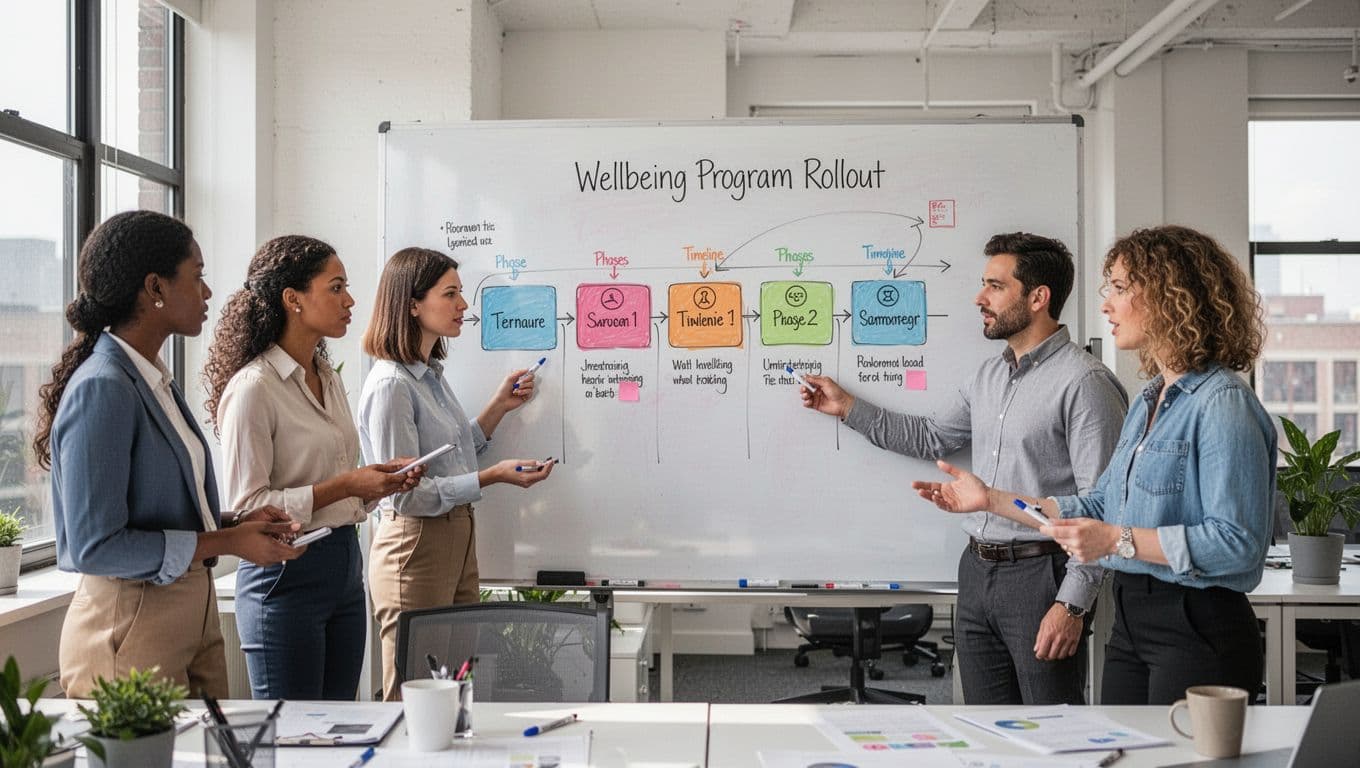
A phased rollout plan being mapped by HR and team champions, created with AI.
Rollouts fail when they're treated like announcements. A wellbeing program is behavior change. That requires time, repetition, and proof.
Use three phases:
- Pilot (2 to 4 weeks): small group, fast feedback, fix friction.
- Launch (2 weeks): clear message, manager reinforcement, micro-habits.
- Optimize (60 to 90 days): measure, adjust, and keep the program visible.
Communications should match reality. Leaders say why it matters and what will change. HR says what's available and how privacy works. Managers model small behaviors and protect time. That's it.
Also, make the first action tiny. Not a 45-minute webinar. A 3-minute reset between meetings.
Mid-rollout, give employees a clean path to try the tool immediately. For example: invite them to download Pausa in English and take their first guided breathing pause the same day.
For global teams and shift workers, plan for asynchronous use. Mobile access matters. So does language. So does not assuming everyone sits at a laptop all day.
A simple 30-60-90 day rollout plan (with owners and deadlines)
This timeline is intentionally tight. It forces clarity.
| Timeframe | What happens | Owner(s) | Deliverable |
|---|---|---|---|
| Days 1 to 10 | Define outcomes, choose 3 to 5 metrics, set privacy guardrails | Exec sponsor + HR | One-page scorecard and policy |
| Days 1 to 10 | Security and access review for tools | IT/Security | Approved vendor list and rollout constraints |
| Days 11 to 28 | Pilot with 5 to 10% of org (mixed roles, shift, remote) | HR + Wellbeing champion | Baseline pulse + weekly feedback |
| Day 21 | Manager enablement (15 minutes, scripts, norms) | People Ops + Internal Comms | Manager one-pager and meeting reset script |
| Days 29 to 42 | Company launch with a single "first action" | Internal Comms + Exec sponsor | Launch note + 2-minute start guide |
| Days 43 to 60 | First habit push (light challenge, team nudges) | Wellbeing champion + Managers | Weekly adoption trend, friction log |
| Days 61 to 90 | Optimization cycle, report-out to execs | HR + Analytics | 90-day scorecard and next-step plan |
The core idea: pilot to remove friction, launch with clarity, then improve based on use, not opinions.
Make adoption easy, and protect trust with privacy and choice
Adoption isn't a motivation problem. It's a design problem.
Make it opt-in. Avoid guilt language. Don't call people "non-participants." Don't make managers chase usage. That turns wellbeing into compliance.
Instead, build simple paths:
- Calendar-friendly pauses: 3 minutes between recurring meetings.
- A one-sentence reset script managers can use: "Let's take 60 seconds, then we'll decide."
- QR codes in the office for deskless teams, so access is instant.
- Mobile-first access for remote and hybrid staff.
On privacy: be explicit. Tell people what you collect, what you don't, and who can see it. Then stick to it. If you use a platform like Pausa Business, keep reporting aggregated and anonymized, and use centralized license management through an admin panel-style setup so HR can manage access without tracking individuals.
For additional context on burnout patterns and why loneliness and stress are showing up as business costs, CANOPY's 2026 write-up on solving for burnout captures the scale of the issue and the retention risk.
Conclusion
A wellbeing program rollout plan isn't a poster. It's a process.
Align leaders on outcomes, budget, and privacy guardrails. Design around real stress moments employees actually face. Then roll it out in phases, measure what happens, and adjust without ego.
Most importantly, leaders must model the behavior. Micro-pauses. Recovery after intensity. Respect for boundaries. People copy what gets rewarded.
If you want a clean next step for February 2026, pick one low-friction intervention to pilot (a 2 to 5-minute guided breathing tool is a strong start), track three metrics for 30 days, then expand based on use, not hope. The goal isn't to look like you care. The goal is to reduce stress in the work itself.